home
about
artists
exhibitions press
contact
purchase
home
about
artists
exhibitions press
contact
purchase |
|
|
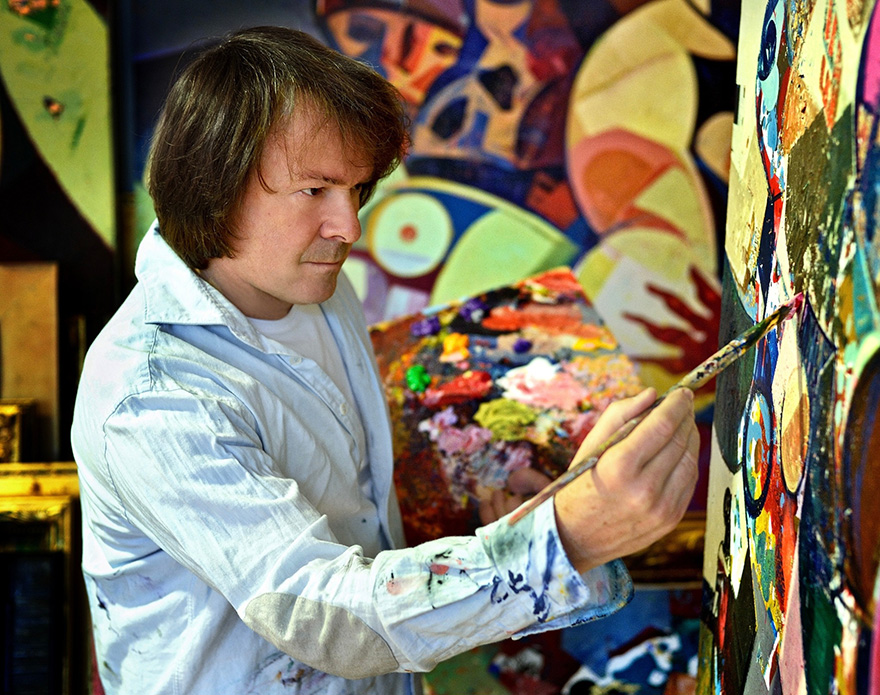
Igor Tcholaria, an artist and graduate of the Mukhina Leningrad Art Academy, is an honorary member of the Russian Academy of Arts. He has risen from the small town of Ochamchire on the Black Sea coast to major galleries in Moscow, London, Brussels, New York, Amsterdam, and Utrecht. Never ceasing to learn, he has thoroughly mastered the entire spectrum of world art, from the Old Masters, French Impressionists, and modernists to contemporary movements, where a profound message often plays a greater role than the image itself. At the same time, he doesn't play postmodernism with its cold parodies of old or recent classics. Tcholaria uses immersion in art history to maximize, often spontaneous, emotional expression and instantaneous vision. This is a special talent. The great masters of bel canto work in a similar way. The ease of his singing is achieved through an exceptional technique honed over decades of work. Pavarotti sings like he breathes. Tcholaria paints like he breathes. Therefore, looking at his art, the viewer also breathes easier. At the same time, if one delves deeper into the artist's work, several main trends emerge. First, it is a portrait. Modigliani immediately comes to mind. The elongated necks of the beautiful women seem to hint at this. But upon closer inspection, one simultaneously senses the gentle power of Raphael, the sublime detachment of Russian icons, and the clear lines of Georgian embossing, rooted in Iranian miniatures. Tcholaria succeeded in synthesizing and refining various ideas and trends in his own internal crucible. A new quality of imagery emerged, instantly recognizable as his own unique style.
Initially, the
artist was captivated by the circus theme, which also featured the
characters of the Italian Commedia dell'Arte, Harlequins and
Colombinas. They freely explored the space of his imagination,
allowing the artist to fully realize the power of his artistic
potential. He is also fascinated by the ideas of contemporary circus
performances in the spirit of the grand Cirque du Soleil, where
acrobatics degenerate into a kaleidoscope of cosmic proportions. If you think about it, it's easy to see that true avant-garde is archaic. Picasso's bull is precisely copied from a cave painting. Primitive genius has echoed in the modern context thousands of years later. Philosophically, Tcholaria's works clearly combine Apollonian and Dionysian motifs. Many of his portraits and landscapes evoke a calm, contemplative mood, which, according to Nietzsche, is the theme of Apollo. Expressive compositions are ordered by the carousel-like swirls of Dionysius. In other words, Tcholaria's work is extraordinarily artistic. The abundance of masks on his canvases creates an additional theatrical effect.
The artist acts not
only as a painter but also as a director of a passionate
extravaganza, where Dionysius and Apollo are presented in harmonious
unity. Many collectors note the positive energy emanating from his paintings. It is no wonder that Tcholaria's works are in the collections of such art connoisseurs as Pavarotti, designer John Galliano, singer Madonna, outstanding hockey player Mogilny, popular French actors Pierre Richard and Gérard Depardieu, and Anthony Hopkins, the tamer of silent lambs. Having traveled extensively across European time and space, Tcholaria received an invitation to hold a major retrospective exhibition at the State Russian Museum in St. Petersburg in 2022. Afterward, his life took another significant turn. He entered the magical realm of Russia's Golden Ring. Tcholaria found himself in Suzdal and was struck by the city's beauty. He immediately purchased the house there and soon experienced an extraordinary creative upsurge. As a result, a new project emerged. Tcholaria plans to hold a series of solo exhibitions in cities along the Golden Ring. Murom was the first in this series. Perhaps it was the heroic aura of Ilya Muromets that marked the beginning of the Golden Path. Evgeny Usvjat
FATE
and the STARS If we imagine an artist as a fantastic being living with images and the emotions these images generate, we could say that the history of world art generously flows through this being's veins. From the first cave paintings to the latest daring stunts of street art hooligans, worth millions. The irony is that, after passing through long classical stages, art has returned to its rock-cut origins. True avant-garde is archaic. Tcholaria inscribed his method in that part of the archaic world when ancient shepherds, without brushes or paints, with a wise gaze painted semi-abstract figures in the starry night sky. Stargazers in theatrical caps read the fates from these stars and were often right. For them, the caps replaced telescopes, and astrology replaced astronomy. Pasternak has a line: "...and the more random it is, the more truly the poems are composed, sobbing..." Like ancient astrologers, Tcholaria believes in spontaneous generators of meaning. He believes that not only is gravity linked to time and space, but so too is the emotional spectrum of the viewer's sensations. Only here we are talking about the space of the canvas, the time in which the artist lives. Tcholaria doesn't simply prepare the canvas for the next work. In accordance with his intuition and emotional state, he begins working with it, creating the colourful and textural foundation of the future work in several stages. Gradually increasing in complexity, the work could emerge as a standalone abstract painting, capable of competing with the masters of this genre. But the artist doesn't stop there. For him, the foundation is the very starry sky upon which the artist vigilantly constructs the final work. This is not simply a prepared underpainting for further work. Rather, it's an emotional springboard for spontaneous immersion in the space of colourful, semi-abstract figures gradually emerging within the painting. The latest theories in physics claim that the visible universe arose from spontaneous fluctuations in the cosmic microwave background. Tcholaría's space not only draws the viewer in like a sudden and mysterious passion, but also warms them with the energy of that passion. Curators of contemporary exhibitions around the world sincerely strive to transform contemporary art into an illustration of fashionable philosophical systems. They want to present the artist as a kind of generator of new ideas, previously unknown to the world. The hooligans of the New York subway created street art as a provocation against bourgeois routine. Having transformed themselves into respectable gentlemen, they fit perfectly into this routine. Hirst's shark is worth millions, and the price of a diamond-encrusted skull is staggering. Thus, the visual arts have become a new fund stabilizing the global economy. They have become like platinum bars stored in bank vaults. It's no wonder that it's into these same vaults, before they can adorn the walls of homes, that paintings, where it would be more logical to list their prices in euros instead of titles, are consigned. The mystical irony lies in the fact that the telling surname of one of the builders of the financial pyramid is Rybolovlev. The oligarch lives in Monaco and fishes in the murky waters of speculative transactions. The businessman inflates a rainbow price bubble, not thinking that the bubble will burst. Perhaps it's just a matter of time. Regarding philosophy, the hitherto unrivaled eccentric from Königsberg, Immanuel Kant, asserted that only two things fill the soul with ever-new and ever-increasing wonder and awe: the starry sky above and the moral law within us. Moral laws, alas, do change over time, while the starry sky remains shimmering, mysterious, and ultimately determining the fate of humanity. Working on the texture of the painting, simulating the spontaneity and glow of the cosmic depths, Tcholaria ultimately constructs his compositions as spontaneous constellations, detached yet warm and friendly. Many collectors note that Igor's paintings gradually begin to exist in the home as equal members of the family, making life more colourful and meaningful. Clearly, such effects don't arise in a vacuum. Besides the artist's energetic personality, originality of method, and sound philosophy of approach, the artist's education, general erudition, and mastery are all significant. Tcholaria mastered the entire spectrum of world art. From the first cave paintings, moving through ancient Greece, the Italian and Spanish Renaissance, he touched upon Russian icons, Georgian coinage, and deeply penetrated the brilliant metaphysics of Rembrandt and Vermeer, the Scandinavian mysticism of Munch, the naive lyricism of Pirosmani, whose million roses will never fade... Plus the enormous influence of the burgeoning stars of Impressionism, Post-Impressionism, the Montmartre bohemia, and the geniuses whose names were made by the Russian merchants Shchukin and Morozov. Alexander Blok apparently attended their exhibitions in St. Petersburg. Isn't this where the poet's line fluttered: "...and once again the world will appear strange, shrouded in a colourful fog...". A colourful fog. A brilliant definition of impressionism. Two words replace volumes of art criticism. Incidentally, the theme of Blok's "The Stranger" became a leitmotif of many of Tcholaria's portraits. Not only Blok's romanticism, but also the sensuality of Modigliani, the tenderness of Raphael, and the sublimity of Russian icons are present in these iconic works. Many of Tcholaria's multi-figure compositions are reminiscent of church stained glass windows, where metaphysics is conveyed through organ-like combinations of light spots. The artist calls his concept "retrospection." Not to be confused with retrospective. Figuratively speaking, the more room you leave yourself for a run-up when retreating into the past, the further, with a powerful push, you will leap into the future. By future we mean not only the airless space of contemporary art, but also the interstellar abysses of emotional artistic insights. The canvases are practically wordless. The columns of the End of Pompeii fall silently. The Ninth Wave silently covers the victims of a shipwreck. But contemporary art has mysteriously acquired sound. The great mute has spoken. It's no wonder one of the most important paintings of modernism is called "The Scream." But Munch isn't the only one screaming. Picasso's Guernica is also echoed by the roar of debris falling from the sky. Tcholaria's paintings have a different harmony. It's easier to compare it to the polyphony of Bach or Vivaldi. At the same time, timpani often thunder in his works, symbolizing the steps of a century as sudden as a stone guest. It must be said that recently, many of his canvases have begun to sound like the evening bells of Russia's Golden Ring. Sometimes it's just the nostalgic ringing of a tired coachman. No wonder. In Lermontov, the stars also converse, discussing someone's fate. The fate of Tcholaria's paintings and his personal life are developing happily. Having toured half the world with exhibitions, he settled in Suzdal, where the sun is reflected in the golden domes every morning.
Taming the Chaos Igor Tcholaria calls his artistic method “retro-perspective” (not to be confused with retrospective). In essence, this means that he moves forward in his creative work from the depths of time, mastery and tradition. Like an athlete who steps back to take a running start before jumping. The kinetic energy of this running start can be extremely great. All that remains is to land on one’s feet. Tcholaria feels confident in his flights, even on the quaky ground of contemporary art. He’s resolutely prepared to weed its tangled thickets, accustomed like a true knight to his palette-knife sword and Cubist-form armour. And fairly recently (stepping back to the Bronze Age for his running start?) he turned to what was a new genre for him: bronze sculpture. Combining a classic approach with the vivid forms of sensual improvisations, he managed in a single stroke to create a whole line of original sculptures that have already won popularity in Europe. Tcholaria was born in the town of Ochamchira, Abkhazia, on the Black Sea coast. He received his initial training at the Sukhumi School of Art, where talented pedagogues taught him the basics of the craft and instilled in him a love for painting. Then he continued his education in Leningrad, at the Vera Mukhina School and Academy of Fine Arts. His work is largely influenced by the French Impressionists along with Pablo Picasso, Amedeo Modigliani and Paul Gauguin. Interacting with each other in the artist’s internal crucible, their creative methods were synthesized into a new quality that became the signature Tcholaria style. In addition, he’s spent years experimenting with the texture of the paint layer, striving for a powerful matte finish instead of glossy garishness. During his student years the works of old European masters had an enormous influence on Tcholaria, who spent much time studying and copying them in the State Hermitage and the Old Russian Paintings Department of the Russian Museum. At the same time, he led the life of a typical informal artist, with all the delights and travails of a semi-underground existence. In the mid-1980s Tcholaria was one of the first to begin earning a living drawing portraits of passersby on the street. At that time in the Soviet Union this occupation was not entirely without risk. Once an observant policeman caught him at work in the square in front of Kazan Cathedral. But the vigilant artist noticed the danger in time. Quickly throwing his brushes into his painter’s case, Tcholaria left the girl he was painting to pose in loneliness and disappeared into the cathedral’s colonnade. The law-enforcement officer wandered among the massive columns for a long time to no avail: you can’t catch artists in a maze, for they feel the rhythms of lines better than others. This feeling of rhythm is a manifestation of Tcholaria’s subtle musicality. Whether calibrating combinations of warm and cool tones, like Cézanne, or painting a broken line with a vibrating hand, like Modigliani, the maestro remains invariably himself. He’s on a first-name basis with these great names, whose ghosts quietly hover over his canvases like spirits in a spiritualist séance. Tcholaria’s female portraits are worthy of special mention. His heroines are funny, mysterious, sly and reckless. At times exotic in an Oriental way. At times colourful and monumental. Clearly, the artist does not always require live models. Images constantly flicker through his soul, like evening fireflies in a Black Sea park. Though Tcholaria often deals with the circus theme, he doesn’t depict scenes in the ring; instead, his attention is drawn to the individual characters. Looking at his paintings, one feels the metaphysical longing of Picasso’s harlequins and at the same time their attempt to escape its grip. The artist seems to soothe his protagonists: “You’re colourful and clever. What do you have to be sad about?” One of his works is entitled Look at Me, Look at Me. A harlequin suddenly flies onto the scene and freezes in mid-air. Like a dolphin jumping out of the water. Or a sail floating over the ocean’s surface. Contrasting icily with the dancer are the melancholy girl present in the image and a blue surrealistic figure in the background. This is like counterpoint in music, when a contrasting tonality emphasizes the beauty of the main theme. No wonder the artist repeatedly admits that he prefers working mainly to classical music. He’s especially inspired by Antonio Vivaldi and Johann Sebastian Bach. For Tcholaria, the idea of taming chaos, which he creates on the canvas using an original technique of abstract underpainting, functions as a sort of generator of striking and unpredictable compositions. At first the artist doesn’t restrain his energy in any way. But at a certain moment he suddenly “chokes his own melody” and gazes at the composition like an ancient shepherd at the starry sky, in which not only Big and Little Dippers appear as if on an abstract canvas, but also wild rams, hunting dogs and other phantoms of the imagination. For all its apparent simplicity, this method requires an ideal sense of colour, outstanding plastic abilities and a highly developed intuition, which allow the artist to discern a metaphysical element in random combinations of coloured patches. When Tcholaria first found himself in Europe, it was just this method of spontaneous insight that allowed him to astonish the European public. Throughout the ensuing years the artist developed and improved his trademark technique. Working in this manner, he never knows exactly how the final result will look. And this is the most important thing in art. Surprise yourself, and you’re sure to surprise the viewer. Even God, according to the Bible, couldn’t hide His amazement after creating the Earth. Once Tcholaria became the involuntary coauthor of a hot trend in the fashion industry. John Galliano acquired one of Igor’s paintings, a variation on his beloved theme commonly entitled General. Somewhat later the artist witnessed a showing of one of the designer’s collections, whose main silhouette in many ways replicated the outlines of his general. Igor took no offence. On the contrary, he was pleased. He realized he’d foreseen a major fashion trend, been on the same wavelength as a celebrated fashion designer. It was probably this shared intuition that led Galliano to acquire Tcholaria’s painting in the first place. Perhaps he did borrow Igor’s visual ideas in his work. But after all, Tcholaria himself synthesized his oeuvre from the ideas of the great French Modernists, who were inspired in turn by primordial African masks and Oriental themes. A traveller’s biography is made up of conquered mountain peaks, lakes, seas, oceans and African deserts. A scientist’s activity consists of discoveries and inventions. A poet mostly records marvellous moments, stringing them onto stanzas and constructing his own imaginary life in this way. A professional artist’s career can be visualized by studying the list of group or solo exhibitions he’s participated in. Since year and venue are indicated in the list, you can thus discover the history and geography of his movements. Looking at Tcholaria’s exhibition roster, we see immediately that his home bases and main places of work are Belgium and Holland. However, England, Italy, France, Luxembourg and the US occupy a worthy place in the registry too. Whilst an explorer leaves his mark on a mountaintop, on the North or South Pole, or at the bottom of the ocean, an artist is commemorated by the people who hold his pictures in their collections. In addition to the aforementioned Galliano, these include the singer Madonna; the late tenor Luciano Pavarotti; actors Pierre Richard, Gérard Depardieu and Anthony Hopkins; hockey player Alexander Mogilny; numerous politicians and businessmen; and most importantly, true lovers of art in all countries and continents.
The World of Tcholaria For an artist living at the turn of the millennium, the art of both bygone and modern times is as much an objective reality as the earth, sky and faces of surrounding people. The iconosphere, our visual memory, the “musée imaginaire” of which Malraux wrote – it’s unthinkable for an artist to be free of these things, for such freedom can easily turn into professional deprivation and ignorance. The famous philosopher Eugenio d’Ors justifiably considered everything devoid of tradition to be plagiarism. In other words, artists who are ignorant of their roots, or attempt to hide them, can hardly lay claim to originality. Igor Tcholaria maintains an open dialogue with art, and his oeuvre exists in a creative space whose visual world is clearly and precisely demarcated. From a young age he’s been captivated by Picasso, though he loves – and most importantly understands – Paul Cézanne, James Ensor, Amedeo Modigliani and Henri Matisse as well. The paintings Tcholaria creates are not imitations; rather, his art is that of a new reality, one that changed completely after the great Spaniard entered it. Joan Miró once confessed that he was fortunate to be able to create in the same world as Picasso. Such sentiments are probably familiar to Igor Tcholaria too. His characters are seen through his own eyes but undeniably through Pablo Picasso’s “magic crystal” as well, with its perception of reality “from the inside out”, its free juxtapositions of different points of view, its depiction of the known and perceived rather than the visible, and its ability to aestheticize emotional discord and the twilight depths of the subconscious. Honoré Daumier maintained that an artist is obliged to belong to his time, and the apparent insouciance of Igor Tcholaria’s paintings doesn’t challenge that thesis in the slightest. However, the modernity of his art consists neither in showing us shards of a “devil’s mirror”, nor in eschatological motives, nor most certainly in any collection of fashionable devices used to force entry into today’s artistic “mainstream”. No, his art is modern because of its ability to resonate with today’s cultural codes whilst preserving its own intonation. Both semantic and visual. Tcholaria doesn’t avert his eyes from the tragedy of existence. But in his variations, which involuntarily bring to mind his deeply revered James Ensor, he peers at the flickering shadows of life like Cabiria in the final scene of Fellini’s eponymous film, seeking and finding in them both poignance and joy. In Tcholaria’s paintings even tragedy retains the flavour of a game or carnival, where the truth hides behind elegant masks and fanciful costumes. Only here the main role is played not by fabric, by clothing, but rather by luxuriant painterly texture, brilliant visual techniques and resonant colour combinations. Tcholaria’s paintings, along with wisdom about the complexity of art and the modern world, are filled with a cheerful, life-giving force, a sense of the invincible beauty of existence. The most common trap for young and ambitious artists is imitation. Especially if they’re little concerned with the inner substance of their art. But when artists have something to say, it’s easier for them to master not only their visual tools but everything they consciously or unconsciously borrow from the existing iconosphere. The content of Tcholaria’s art is positive, filled with vitality, energy and joy. That holds true both for his early works – sultry decorative landscapes splendidly embedded in their canvas surfaces – and for the later portraits that seem to combine reminiscences of Modigliani’s sitters with the fleeting elusiveness of anxious contemporary faces. The latter are more forceful and dramatic: their fiery chromatic effect and juxtaposition of different viewpoints (The Woman with a Yellow Bird, 2003) seems to reveal the subjects’ characters at different moments in time. Even more lapidary is Woman in a Red Hat (2002), a painting that goes beyond live portraiture to produce a non-figurative impression, revealing the model’s essence in an original way, like an accompaniment. As Ignacio Zuloaga noted, “Art must be vital and free, and under no circumstance the slave of reality.” Tcholaria, despite his cheerful openness to the world, is not as simple an artist as he might seem. His universe, like any carnival, hides behind its masks, exotic costumes and whirling farandoles a certain alarming subtext, a hidden Hoffmannesque element. And only his generous wealth of powerful colour combinations and elastic, seemingly dancing lines – “the substance of art”, in a word – is able to quell the anxiety that arises from the subtle ambiguity with which every work by Igor Tcholaria is deliberately infused.
Mikhail German,
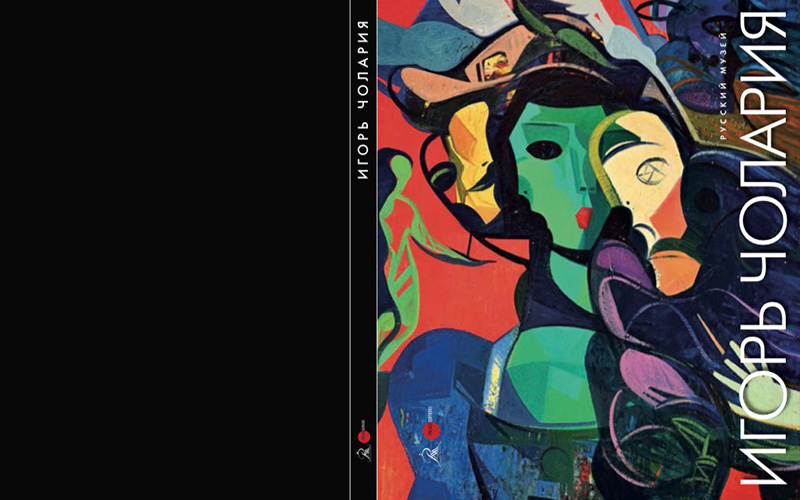
“Returning to the past, I move forward.” - Artist Igor Tcholaria Igor Tcholaria has a studio at the famous 10 Pushkinskaya Street in St Petersburg, a former squat occupied by artists back in the perestroika years. These representatives of the “other” culture existing in parallel to the officially approved one were often referred to as Nonconformists. They rejected the principles of creative life that existed in their country, orienting themselves towards the global artistic process they longed to participate in. Tcholaria belonged neither to their ranks nor to those of the officially recognized painters of the time. A non-revolutionary by nature, he wished only to be an artist, not to repudiate anything. Perhaps this is why he met with such success in foreign galleries, where he chanced to be exhibited, noticed and singled out from among other street portraitists from Leningrad, soon to be renamed St Petersburg. At that time, in 1987, he and his comrades were among the first creators of our country’s own “Montmartre”. Later, towards the beginning of the 2000s decade, he returned to the cultural environment of Russia’s second capital with the rich experience of foreign creative work behind him. “Holland, Belgium, London, Monaco – in these countries and cities there’s great interest in art in every home,” the artist observes. The galleries he worked with then, and continues to collaborate with today, allow him complete creative freedom. Tcholaria strives to stay in the mainstream of contemporary Russian art, defining his creative method by the term “retro-perspective” and adhering to the credo “Returning to the past, I move forward.” In this connection, it’s telling that the artist bought back a number of his works from their Dutch owners to modify and improve decades after their creation. But the essence of Tcholaria’s credo lies elsewhere: in the formal structure of his works and his passion for avant-garde art. “I adore the great art of the early 20th century,” he confesses. Captivated by turn-of-the-20th-century French art at the beginning of his career, Igor Tcholaria began painting landscapes in the French Impressionist style. Later he made a careful study of the Post-Impressionist masters. It seems that his beloved themes of the theatre, circus, commedia dell’arte and equilibrists were largely influenced by the “French” spirit too, for by the 20th century the “comedy of masks” had extended its influence both to French art (here we must mention Pablo Picasso, whom Tcholaria reveres) and Russian culture of the Silver Age. The theatre, circus and itinerant life: this is a logical collection of themes for a well-travelled artist. In addition, the theatre and circus are attractive for their multicoloured variety, transformations and unending motion. This is Tcholaria’s creative oxygen, his native element. However, the artist treats these themes in a melancholy rather than phantasmagorical vein. It’s no accident that his pensive, seemingly inquisitive figures are often accompanied by masks (held in their hands, appearing to hover nearby, and so forth), which play a significant role in Tcholaria’s world. His most recent mask-portraits bear the tragic imprint of Filonov’s Heads, though in the context of Tcholaria’s oeuvre they also express the element of sensuality found in his multi-figure compositions. Flowers, women and dolls are also favourite themes for the artist. On the one hand, women resembling flowers, or women with flowers. On the other, the image of the doll, which like the mask represents the dark side of feminine nature, its tendency to devolve into a marionette in rapacious hands. The portraits of women, even those with specific names, exhibit a conventionality of feature, a visual generalization. Dazzlingly beautiful, they occupy a place alongside the female images of such artists as Amedeo Modigliani or, in particular, Lado Gudiashvili, who wrote: “Woman is the source of life and goodness, … the crowning glory of nature and embodiment of its inexhaustible abundance.” Of the aforementioned painters Tcholaria rates Modigliani the highest, together with Marc Chagall and Henri Matisse. “We must never forget the classics,” the artist declares. Female images are present in almost all of Tcholaria’s works, dictating their will in some strange way, taking the helm of world governance, or assisting in recreating the world from chaos. The latter role is especially pronounced in the artist’s multi-figure compositions from the last decade, which he paints in multiple layers over several sessions. Having invented his own priming method, he’s convinced that paintings should be saturated visually as well, so that one can “read” a plot in their forms, lines, fanciful contours and luxuriant colours. “There’s structure present even in apparent chaos,” Tcholaria explains, describing the synthesis of abstraction and figurality in his works, some of which are exquisitely textured, others, on the contrary, flat and pointedly decorative. In his paintings-narratives he combines texture and laconic patches of colour, later adding smaller details. The world that arises in them is bright and variegated, rich with colour and eddying forms. Encoding “reflections on the realities of life”, in the artist’s words, it contains in its formal structure echoes and reminiscences of various languages of avant-garde art. In their time, each of the classic artists of the international avant-garde spoke in their own language, and each wove their own original artistic fabric that entered the history of art as a unique visual unit for future generations of painters. Tcholaria’s method, which has evolved over the years, uses aesthetic material from the past and organizes pictorial space via a montage technique the artist calls “combinatorics”. However, this organisation is preceded by the chaos of spontaneous abstract improvisation, often using the methods of Jackson Pollock, only after which does work with semi-figurative forms begin. Multiple layers of coloured priming also contribute to the effect of form arising from chaos. While focusing intently on avant-garde art – so close to us and yet so distant in time, already a classic for today’s generations – Igor Tcholaria nonetheless remains a free artist who pays tribute to the joy of creativity and regularly pokes fun at himself. His work eludes precise definition: Postmodernist? Quite possibly. Neo-Eclectic? Neo-Mannerist? In the end, he’s just an artist who can’t imagine himself in another role. Tcholaria’s artistic credo is perhaps most personally reflected in the unexpectedly minimalist work entitled Flowers of Malevich. In the mysterious abyss of a black square sunken into the canvas’ woven fabric flashes of colour shimmer – brightly, triumphantly, yet with an odd kind of humility. Painting lives on. The Cover of Russian Museum Catalogue 2022 of Works by Igor Tcholaria
Catalogue from the Russian Museum (issuu) Catalogue from the Russian Museum (pdf) |
|
 artist
return artist
return
 |
E-mail: info@hayhillgallery.com |